RBI Policy Update: What Does It Mean for Your Investments?
September 7th, 2026 News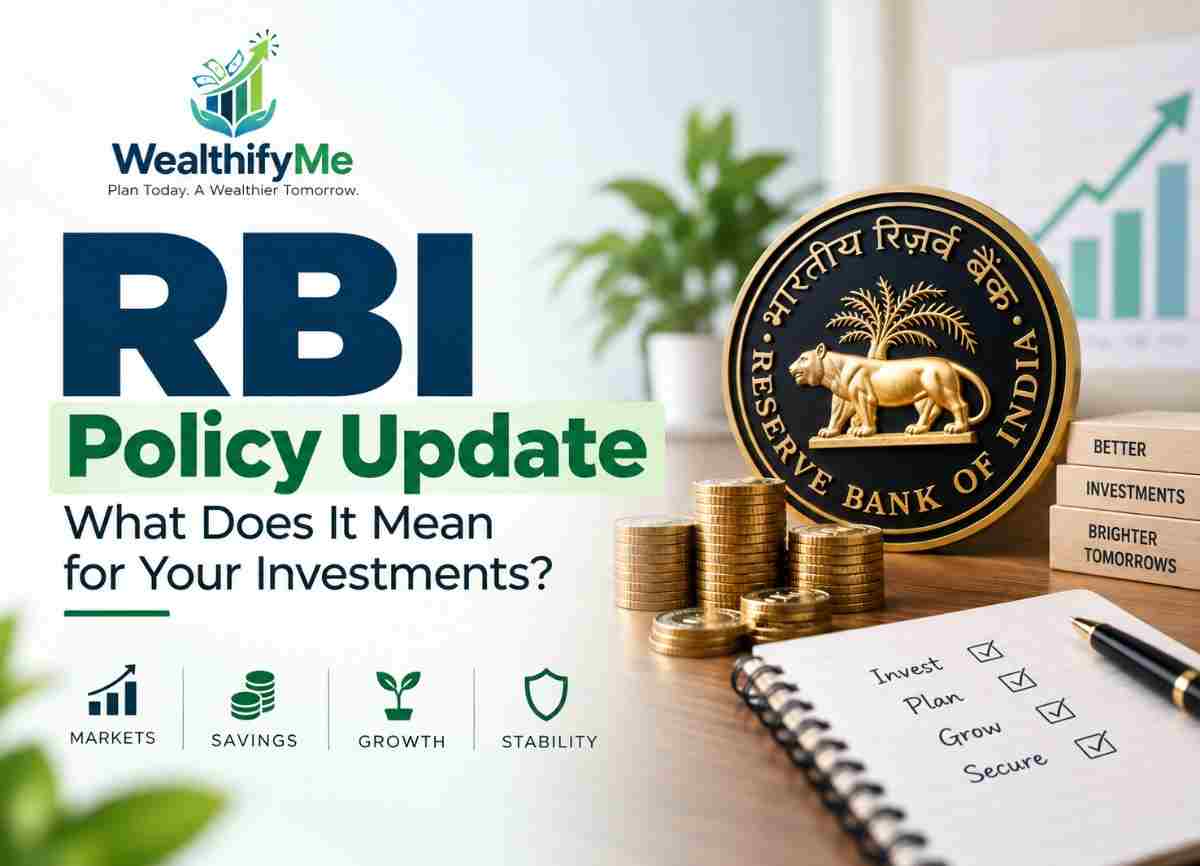
RBI Policy Update: What Does It Mean for Your Investments?
The Reserve Bank of India (RBI) plays an important role in shaping India’s financial and investment environment. Every change—or decision not to change—its monetary policy can influence interest rates, loans, fixed deposits, bonds, mutual funds and overall market sentiment.
In its August 2026 Monetary Policy Committee (MPC) meeting, the RBI kept the repo rate unchanged at 5.25% and maintained a neutral policy stance. The decision was unanimous. The RBI also retained the Standing Deposit Facility (SDF) rate at 5.00% and the Marginal Standing Facility (MSF) and Bank Rate at 5.50%.
But what does this RBI policy update actually mean for investors?
Whether you invest through mutual funds, SIPs, fixed deposits, bonds or other financial instruments, understanding the impact of interest-rate decisions can help you make more informed investment decisions.
What Is the RBI Repo Rate?
The repo rate is the rate at which the RBI lends short-term funds to commercial banks. It is one of the most important tools used by the central bank to influence liquidity, inflation and borrowing conditions in the economy.
When the repo rate changes, it can eventually affect:
-
Home and personal loan interest rates
-
Fixed deposit rates
-
Bond yields
-
Debt mutual funds
-
Equity market sentiment
-
Overall investment conditions
In August 2026, the RBI decided to keep the repo rate at 5.25%, continuing its neutral stance.
For investors, this means the current environment calls for careful portfolio planning rather than making investment decisions based solely on one policy announcement.
Latest RBI Policy: Key Highlights for Investors
The August 2026 RBI policy provided several important signals for the Indian economy.
1. Repo Rate Remains at 5.25%
The RBI maintained the policy repo rate at 5.25%. This was the fourth consecutive policy meeting in which the rate remained unchanged.
For investors, a stable repo rate can provide some stability to interest-sensitive investments and borrowing costs.
2. RBI Maintains a Neutral Stance
The RBI retained its neutral monetary policy stance, indicating that future decisions will depend on incoming economic data, inflation trends and growth conditions.
This is important because investors should avoid assuming that the next policy decision will automatically result in either a rate cut or rate hike.
3. Growth Outlook Remains Positive
The RBI raised its FY2026-27 real GDP growth projection to 6.7% from 6.6%. Quarterly projections included 7% for Q1, 6.4% for Q2, 6.5% for Q3 and 6.8% for Q4.
A resilient growth outlook can be supportive for businesses and, over the long term, can contribute to a constructive environment for equity investors.
4. Inflation Remains an Important Factor
The RBI revised its FY2026-27 CPI inflation projection to 5%, while highlighting risks from food and fuel prices, geopolitical developments and global economic uncertainty.
For investors, inflation matters because the real value of money can decline when prices rise. This makes long-term wealth creation and inflation-adjusted returns important considerations when building an investment portfolio.
How Does the RBI Policy Affect Your Investments?
The impact of RBI policy is different for every asset class. Your investment strategy should therefore depend on your financial goals, investment horizon and risk profile.
Impact on Mutual Funds
RBI policy decisions can influence different categories of mutual funds in different ways.
Equity Mutual Funds
Equity mutual funds are primarily influenced by corporate earnings, economic growth, valuations, liquidity and investor sentiment.
A stable interest-rate environment combined with a positive growth outlook can be supportive for equities, although market movements can still be affected by global events, valuations and company performance.
For long-term investors, SIPs in diversified equity mutual funds can help maintain investment discipline instead of trying to predict every RBI policy decision.
Debt Mutual Funds
Debt funds can be more directly sensitive to interest-rate movements.
When interest rates fall, existing bonds with higher coupon rates can potentially become more attractive, which may support bond prices. Conversely, rising interest rates can create pressure on existing bond prices.
Therefore, investors considering debt mutual funds should understand interest-rate risk, credit risk and investment duration before investing.
Impact on Fixed Deposits
Fixed deposits remain popular among conservative investors.
When the RBI keeps policy rates stable, banks may have less immediate reason to significantly change deposit rates. However, FD rates are also influenced by factors such as banks' deposit requirements, credit demand and market conditions.
The RBI's current policy environment therefore makes it important to compare FD rates, tenure, liquidity and taxation rather than selecting an FD purely because of its advertised interest rate.
Impact on Bonds and Government Securities
Interest rates and bond prices generally have an inverse relationship.
When market interest rates rise, existing bonds with lower coupon rates may become less attractive, potentially putting pressure on their market prices. When rates decline, existing bonds may benefit.
This is why RBI policy announcements are closely watched by investors in government securities and bond markets.
What Should Investors Do After the RBI Policy Update?
The biggest mistake investors can make is changing their entire portfolio after every RBI announcement.
Instead, consider these steps.
1. Review Your Financial Goals
Ask yourself why you are investing.
Are you investing for:
-
Retirement?
-
Children's education?
-
Buying a home?
-
Wealth creation?
-
Emergency planning?
-
Short-term financial requirements?
Your investment strategy should start with your goal—not the latest headline.
2. Match Investments With Your Time Horizon
Short-term money and long-term money should not necessarily be invested in the same way.
Money required within a short period may need relatively lower-risk and more liquid options, while long-term goals may allow investors to consider growth-oriented assets depending on their risk profile.
3. Diversify Your Portfolio
A well-planned portfolio should avoid unnecessary concentration in one asset class.
Depending on your objectives and risk tolerance, diversification may include a combination of:
-
Equity mutual funds
-
Debt investments
-
Fixed deposits
-
Government securities
-
Gold
-
Other suitable financial instruments
Diversification does not eliminate investment risk, but it can help manage concentration risk.
4. Continue SIPs With Discipline
For long-term mutual fund investors, RBI policy announcements should not automatically determine whether to stop or start an SIP.
A systematic investment approach can help investors maintain discipline across different market cycles.
However, the right mutual fund category and SIP amount should be selected according to your financial goals and risk profile.
Why Professional Investment Planning Matters
Financial markets can react quickly to RBI decisions, inflation data, global events and economic developments. For an individual investor, it can be difficult to determine what actually matters for their personal portfolio.
This is where professional financial guidance can add value.
At WealthifyMe, the focus is on helping investors understand their financial goals, risk profile and investment requirements before making investment decisions.
Instead of simply reacting to every market headline, investors can focus on creating a structured and goal-oriented investment strategy.
Whether you are starting your first SIP, reviewing an existing mutual fund portfolio or planning for long-term wealth creation, having a clear financial strategy can make the investment journey more disciplined.
Frequently Asked Questions
1. What is the current RBI repo rate?
As per the latest RBI policy information, the repo rate is 5.25%. The RBI has also maintained a neutral monetary policy stance.
2. Does the RBI repo rate affect mutual funds?
Yes. Changes in interest rates can influence different mutual fund categories, particularly debt mutual funds. Equity mutual funds can also be affected indirectly through borrowing costs, liquidity, economic growth and market sentiment.
3. Is it a good time to invest in mutual funds after the RBI policy?
There is no single answer for every investor. The decision should depend on your financial goals, investment horizon, risk tolerance and existing portfolio rather than the RBI policy alone.
4. Will the RBI policy affect FD interest rates?
RBI policy can influence the broader interest-rate environment and therefore affect FD rates. However, banks also consider their deposit requirements, credit demand and competitive conditions when setting FD rates.
5. How can WealthifyMe help with investment planning?
WealthifyMe can help investors approach their investments through a structured, goal-oriented process. Instead of making decisions based purely on market news, investors can evaluate their goals, risk profile and portfolio requirements before investing.
Conclusion:
The latest RBI policy update, with the repo rate maintained at 5.25% and a neutral stance, highlights the importance of watching inflation, economic growth and global uncertainties while making investment decisions.
However, successful investing is not about predicting every RBI decision or reacting to every market movement.
It is about having a clear financial goal, suitable asset allocation, disciplined investing and regular portfolio reviews.
If you are looking for professional guidance for mutual fund investment, SIP planning and long-term wealth creation, WealthifyMe can help you build a more structured approach to your financial journey.
Plan your investments with purpose. Build wealth with discipline. Choose WealthifyMe for smarter financial planning.
Mutual fund investments are subject to market risks. Read all scheme-related documents carefully before investing.